

On Christian Hope: The New Encyclical of Pope Benedict XVI


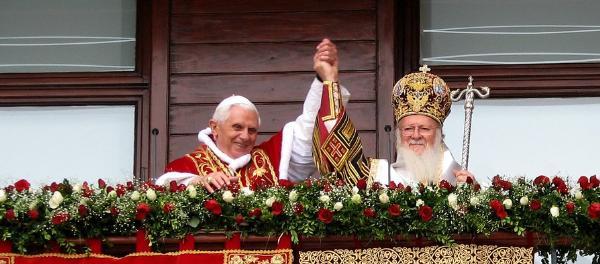
James Corkery SJ, of Dublin's Milltown Institute analyses the message of the Pope's latest encyclical, Spe Salvi.
On 30 November 2007, just before the beginning of the season of Advent,
Pope Benedict XVI issued his second encyclical letter, Spe Salvi. Appropriately
for the advent season, its theme was hope.
Pope Benedict treated in his letter of the specific character of
Christian hope. Aware that there are
many menus of 'hope' presented to us in the world of today, his desire was to
express that hope upon which men and women could trustingly rely. This is the hope that has God as its
foundation, for, as Saint Paul makes plain (Ephesians 2:12), without God there
is no hope - no future but darkness (2).
href="#_edn1" name="_ednref1" title="">[i]
Spe Salvi did
not quite capture the attention of the media in the way in which Benedict's
first encyclical letter, issued on 25 December 2005, did. Yet there are similarities. Deus
Caritas Est, the first letter, was a celebration of love; but its ultimate
purpose was to speak of the love that God is, a reliable and faithful love; an
absolute love; a love that purifies our own imperfect loves, giving them
meaning, solidity and direction. Both
in the case of love and in the case of hope, Benedict XVI is choosing what is
at the heart of our humanity - we are made for love, we cannot exist without
hope - and he is showing the counterfeits of these in the contemporary world
and opening a perspective on true love, true hope, that will save and not
demean us. In this way, both
encyclicals belong together. Each seeks
to deal with what is truly salvific, truly redemptive for humanity.
WHAT DOES THE ENCYCLICAL LETTER SAY?
Fundamental
Aspects of Christian Hope (the New Testament and Early Christianity)
In the first part of his encyclical, Pope Benedict looks to a number of
New Testament and early Christian writings in order to capture the true
identity of Christian hope. He points
out how 'hope' is so central to biblical faith that, in several places, the
terms 'hope' and 'faith' seem almost equivalent (2). The words from Saint Paul with which the encyclical begins - "in
hope we were saved" (Romans 8:24) - point to the "trustworthy hope" that has
been given to us, not just as information about our future but also as
something that enables us to live in our present, even if this present is arduous,
and to shape our lives in a new way (1, 2, 4, 10). Thus the Christian message of hope is 'performative' as well as
'informative'. It comes to us when we
encounter God - as Pope Benedict illustrates beautifully through the life-story
of the recently canonized, nineteenth century African saint, Josephine Bakhita
(3) - and we receive it as a gift. A
trustworthy hope like this is not something that we can ever give ourselves
(1).
The hope that comes from encountering God relativizes all other, limited
hopes because it is "the great hope," assuring us that a definitive Love is
ours and is awaiting us. This love is
made visible in Jesus, who was not a social revolutionary bringing an external liberation but rather, in his
love 'to the end' on the Cross, was someone who brought a very different
reality: an encounter with the living God that changed the world from within (4, also 27). Benedict
focuses on two images from early Christianity to describe Jesus, the Christ:
that of philosopher and that of shepherd (6). As the first, Jesus teaches us what it is to be truly human; as the
second, he walks with us in the valleys of life - and indeed into the valley of
death. The hope that he brings
illustrates that death itself is no longer to be feared. In a nutshell, then, the substance of New
Testament hope relativizes the habitual foundations of well-being (material
security, etc.) and provides an objective certainty, not just a subjective
conviction, about a future that is real and that can be relied upon (thus
paragraphs 7-9, a rather professorial treatment completing the encyclical's
first main section).
What Christian Hope is Not...
In a move rather typical of the writings of Joseph Ratzinger/Benedict
XVI, the Pope now turns to an examination of what hope is not. Having pointed out
that 'eternal life' is at the centre of Christian hope, he quickly shows
awareness of how, on the one hand, we do not want to die and, on the other
hand, we cannot countenance living indefinitely. So our attitude is paradoxical, giving rise to the deeper
question of what 'life' and what 'eternity' actually are (11). He argues that the term 'eternal life' is an
inadequate one seeking to express an 'unknown' of which we are aware, for which
we yearn, and which yet eludes us. It is
something like 'life itself', a plunging into a sea of love with a deep
satisfaction that is something entirely different from contentment in a
temporally successive sense. It is
relationship, immersing us in an ocean of joy. It is relationship involving unity with God and with one another, not
some private 'satisfaction' centred on me alone (12, 13, 27). Christian hope is social and communal in
character; it is a 'blessed life' (Augustine) involving a 'we', indeed
expressing a 'we' (14, 15).
'Eternal life', then, is not individual, private self-satisfaction in
endless time; that is what our hope is not. And a notion that has emerged in modern
times - not least to counter such a distorted view - is not what Christian hope
is either, for it leaves God out of the picture and seeks to base hope on
humanly-created realities. Here Benedict has in mind 'faith in
progress', encompassing an unbridled trust in the power of autonomous reason
and its possibilities: freedom from all dependency, the self-realization of
humanity (17, 18). In the period of
modernity, Christian hope became transformed into this idea (16-23), which
promised a future it could not deliver, will never deliver because fragile
human freedom is ever-capable of placing it in jeopardy. To rely on the creation of structures that
will usher in such a self-realized future for humanity is mistaken. Karl Marx's error, for example, was not a
failure to uncover what was unjust and needed changing; nor did it consist in
his not knowing how to overthrow the existing order (quite the contrary, in
fact); rather it consisted in forgetting that human beings are human beings,
always therefore free, and always therefore capable of choosing evil too, no
matter how well the economic environment has been shaped (21). His error, in short, was materialism. And so we are still faced with the question:
what may we hope? (22f.).
What Christian Hope Is...
To answer the
question of what we may truly hope, a self-critique of modernity and, indeed,
of modern Christianity is needed. This
will quickly show the ambiguity of 'faith in progress' when progress is
confined to the scientific dimension of life. For, thus confined, it is detached from God, as also are the concepts of
'reason' and 'freedom' accompanying it; and without God there is no hope (22,
23). Despite the good that science can
achieve in making the world a better place, it can also destroy the world if it
is not guided by what is outside itself, namely, recourse to God and to "the
moral treasury of the whole of humanity" (23-25). Appeal to this treasury is a must for ever-fragile human freedom;
ethical reflection must keep pace with technical advances; otherwise our
reason, which we think will 'save' us, will in fact do the opposite. Reason needs to be connected to faith if it
is to direct us to what is truly good. Science alone cannot save; only love can save. 'Life' is ultimately guaranteed only by the God of life (25-27).
Human beings
need unconditional love and we can never give that to ourselves. Absolute love is received - received from
God in Jesus Christ, through whom "we have become certain of God" (26). In him our true hope is found; his 'love to
the end' expresses what truly gives us 'life'. So, 'life', true life, fullness of life, is a gift to us; it is
relationship, and we cannot give it to ourselves. Here Pope Benedict is returning to the positive meaning of
'eternal life' already hinted at earlier; and it is this that is our lasting
hope. It is this that constitutes 'the
great hope' that transcends all our particular searches for hope, announcing at
the same time both their meaningfulness and relativity (30-31). But how is it possible to re-connect with
this hope? To show us, Benedict
identifies what he calls three 'settings' that will help us to learn and
practise Christian hope (32-48).
'Settings' within
Christian Life that Offer a Pathway towards, a Pedagogy into, Hope
Prayer is the
first. Quite simply, it offers the
assurance that, when no one seems to be there for me, there is someone to whom
I can always talk, and who will always listen to me. In prayer, God opens us up; opens us up for God and opens us up
towards others. In prayer, God purifies
and strengthens our desires, enlarging our hope and developing in us hope for
others as well. In prayer, we speak to
God communally, liturgically, as well as personally. Prayer makes us hopeful and enables us to give hope to others
(32-34).
Action and
suffering are the pair of 'settings' that Benedict mentions
second. Because there exists that
'great hope' against the background of which all our actions and efforts take
place, we can persist in those actions, no matter how futile they may seem at
times. For we know that our own lives, as
well as history in general, "are held firm by the indestructible power of Love"
(35). With suffering, something similar
is the case. Rooted in our finitude and
our sinfulness, suffering will always be part of human existence. However, a God who personally enters history
as a human being and suffers within it shows us that what we cannot do will be
done by God. Thus there is a justice to
be looked forward to that we cannot be expected to achieve but that, because we
can hope in God who, in suffering with us, has overcome evil for us, enables us
to continue in our own efforts to overcome evil and reduce misery. Far from losing the capacity to suffer for
others because God, in Christ, has suffered for all, we gain the capacity to
suffer with him for their sake - because we have hope from what he has done
(36, 39-40).
Finally, the Judgment is the
third 'setting' in which we can learn and practise suffering. This is because the judgment promises a
justice that this world cannot give. If
the latter depended on itself for ultimate justice, we would be without
hope. The strongest argument for faith
in eternal life, the Pope writes, is that - deprived of the image of the last
judgment, an image of hope, not terror - the world would be abandoned to the
injustice of history as the final word, without redress. But there is redress because God is just and
creates justice, a justice that is also grace. The former assures us that the final outcome will not be some fudge covering
the evil that has been done; but the latter offers us hope, for the Judge is
our advocate as well (42-44, 47).
Some Reflections on Spe Salvi
This encyclical is not as 'fresh' and eye-catching as Deus Caritas Est was. It reads
more like a typical essay in theology by Joseph Ratzinger/Benedict XVI,
incorporating many of his key ideas and his tried-and-tested theological
method: starting with the biblical material for the specifics of Christian hope, then outlining what hope is not (in a
critique of this-worldly approaches) and following that with a presentation of
the true shape of Christian hope. The
'settings' for learning and practising hope that constitute the last part of
the encyclical are somewhat of a novelty, not so much in content as in style.
There is a good deal of continuity with Benedict's previous writings,
both as theologian and as Prefect of the Congregation for the Doctrine of the
Faith, since, as with them, so with this letter he has an 'enemy' in view,
namely: false ideas of hope that conceive it as something that we can make
rather than as a gift we must receive. Once we think of hope for the future as that which results from
scientific and technical progress, or from social revolutions and the
states-of-affairs that they usher in, then we abandon ourselves to a salvation
of our own making; and this is no salvation at all. Echoes of Cardinal Ratzinger's legendary opposition to liberation
and political theologies are audible here. Everyone will readily agree, of course, that a salvation that depends only on human social activity is
hopeless - is no salvation at all. Nonetheless it might not be necessary to conclude from this that all
projects for social transformation are thereby necessarily non-runners. An astute reader of the encyclical has
observed that, in the promises for the renewal of creation, for a new heaven
and a new earth, and for the summing up of all things in Christ that are found
in the New Testament, there still remains a basis for conceiving salvation in
decidedly collective as well as in
individual terms: as a world renewed, as the kingdom coming ("on earth as it is
in heaven").
title="">[ii]
Pope Benedict's analysis of the period of modernity and of its
characteristic mind-set constitutes a robust naming of the limitations of
Western European (and, to an extent, North American) culture and life. For many years he has been concerned about
how Christian faith is losing all voice in the shaping of public life in Europe
at present, despite the fact that the roots of Europe are Christian. Thus he is on a mission to gain a hearing
again for the Christian voice in the public sphere in Europe. This might explain why, in the encyclical,
more of the things that have been threatening humanity in Europe are to the
fore than are the threats - indeed the phenomena of 'unsalvation' - that
frighten, actually beget terror, in the minds of many of the world's peoples
outside of Europe as they contemplate the earth's rising temperatures and
recall the disasters that in recent memory have blighted countless lives in
Asia, Africa and other places. From
elsewhere there is evidence that the Pope's concern about environmental and
ecological matters is growing rapidly, but these things do not loom especially
large in this encyclical on hope.
All encyclicals are serious Church teaching - not ex cathedra statements, to be sure, but a very high level of
ordinary papal teaching - and this one is no different. This means that, while offered for believers' reflection and careful consideration
(it is addressed to them), it is not at all presented with the kind of open
invitation to criticism as was, for example, Pope Benedict's
recently-published, personal-theological
book, Jesus of Nazareth. I remember a theologian - Thomas Söding,
writing in June of last year in the periodical Herder Korrespondenz - saying that that book would present the canon lawyers with an unenviable
challenge because of the kind of genre that
it represents: at once personal and papal.[iii] This encyclical brings with it an even more
daunting challenge for them, so close is it to the rich, personal intellectual
achievement of this theologian-Pope that it is difficult not to be inclined to engage with it in a theologically
argumentative way, even though it cannot come equipped with an open invitation
to do so.
Spe Salvi definitely
represents a novel kind of papal teaching, with its very personal style and its
quoting, even, of particular philosophers from the Pope's own homeland and
intellectual background, such as Immanuel Kant and Theodor Adorno. It invites its readers to ponder and
consider, as it follows an almost conversational style of raising a question
here, suggesting an understanding there, illustrating by an example somewhere
else. Its tone is reflective and
invitatory. For some remarks that I
penned, on 3 February 2006, in The
Catholic Herald on Benedict XVI's first encyclical, that newspaper chose
the heading: "a professor with an eye for precision and a pastoral touch". The same would really be appropriate for
this encyclical, in which the practised teacher is gently and persuasively
plying his trade.
Concluding Remarks
The encyclical is speckled with gems of observation and insight: stories
or examples illustrating lives lived in hope or new 'takes' on old ideas that
bring lost hope back into the picture. What Benedict says about the traditional practice of 'offering up'
life's annoyances and hardships will make practised readers of Christian texts
think again (40), as will his remarks concerning the long-standing doctrine of
purgatory (45-48). His concern in all
these matters - and indeed in the text overall - is anthropological: it is to present a correct understanding of
genuine human hope. We human beings need hope in order to live;
and the Pope wishes to spell out the true hope that will sustain us, preventing
it from being whittled away by the false hopes that are on offer
everywhere. He seeks to present a hope
that is the salvation, not the destruction, of humanity. This hope is a gift, an offer of relationship,
an invitation to life. And it has a
face, the face of absolute love, the face of God revealed in the
love-to-the-end of his beloved Son, Jesus.
James Corkery SJ lectures in Systematic
Theology at the Milltown Institute, Dublin. He has recently completed, in
the Irish Dominican Journal Doctrine & Life, a series of seven articles on the
theology of Joseph Ratzinger, now Pope Benedict XVI.
 Milltown Institute, Dublin
Doctrine & Life
name="_edn1" title="">[i]Wherever
numbers appear in brackets, they refer to specific paragraphs of the Encyclical
letter.
name="_edn2" title="">[ii]See Tom
Wright, "And what of this world?" in: The
Tablet (8 December 2007): 10.
name="_edn3" title="">[iii]See Thomas
Söding, "Aufklärung über Jesus. Das Jesus-Buch des Papstes und das Programm
seines Pontifikates" in: Herder
Korrespondenz 61 (6/2007): 281-285.