
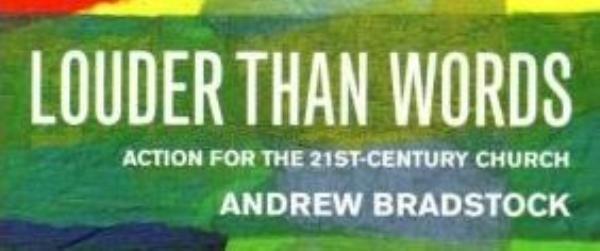
Louder Than Words: Action for the 21st-Century Church


This
is a compelling introduction for those that seek to make sense of a faith that
does justice. Broad in scope it is not simply a book for beginners though.
Bradstock's approach is to assume that faith must be about social change and
then to elucidate a number of frameworks and strategies by which voice can be
given to such a commitment.
Here
then are case studies of social entrepreneurs who have opened co-operative NHS
dental practices. Here also are
examples of the contribution of Pax
Christi and others to conflict resolution. The pro-migrant worker campaign
endorsed by Cardinal Murphy O'Connor and Archbishop Vincent Nichols, Strangers Into Citizens, is also praised
as well as the huge patchwork of networks that came to be the faith-based input
into the Make Poverty History
campaign. The Greenbelt Festival for young Christians features as does the Faithworks movement founded by the
energetic Baptist pastor, Steve Chalke. Inter-faith projects from Lancashire
gain a mention as do Christian socialists in parliament. The ambition is broad
but the pace still allows for breath and a moment of enquiry for those
encountering religion for the first time.
Throughout
the reader can sense the judicious combination of an academic in dialogue with practical endeavours. Bradstock has
previously written on liberation theology and 17th Century radical
English Christianity. He has also been a parliamentary candidate and National
Secretary for Social Affairs at the United Reformed Church.
If
the book does have weaknesses they are probably to be found in the subject
matters it has chosen not to cover rather than those that it does: While there
is thoughtful consideration of the importance of politics there is little
reflection on the shifting sands of wider institutional leadership tasks in
society today: arguably in the last century the UK and US voluntary sector has
shifted from a culture of membership participation to the management of donors as
"lists" and "contacts". This has hollowed out the civic sphere.
Businesses
may be seeking to be more socially responsible but as they engage in the
delivery of publicly procured services they are not content to enshrine human
rights legislation in their habits. Meanwhile, the rise of the "public
manager", who seeks to insulate the state from resource-seeking lobby groups,
means that the role of the political activist is increasingly constrained.
Conceivably even a radical call to action, such as the present work, might
benefit in its next edition from theologies of public management, social profit
making and the possibilities of delivering anti-poverty programmes beyond the
realm of government and NGOs. This would not be some traditionalist call to
"business ethics" but a rigorous reflection on the variety of forms of
capitalism that have exploded onto the world stage since 1989 - and the
over-consuming decadence that ideas such as Gross Domestic Product and Gross
National Product cannot capture. A fresh politics will surely need a new
economics.
But
there is a deeper problem in Bradstock's enthusiasm for "Christian motivation"
as the key driver of faith based civic action as well: the reality of the life of coalition builders, such as Make Poverty
History, is a permanent need to enable
those who think "wrongly" to act "justly" even before they realise its true
sense. That is why so much energy has to be expended in building and rebuilding
networks of support for social renewal. It is also why so many long term
activists can be appalled by younger ones who would like to enjoy their
campaigning as much as achieve change by it. And why both of those are shocked
when a certain breed of new changemaker will not touch a cause which has no
prospect of victory.
However,
all is not lost. Bradstock is now moving forward to contribute to a series of
major studies in the field of religion , public policy and the role of the
voluntary sector. This will make Louder
Than Words the opening contribution to a wider conversation rather than the
one-off handbook for activists in the making that it purports to be.
Until
then this book is to be highly recommended. It will set the mind thinking. It
will encourage the heart to beat a little faster. It inspires - and enrages. As
such it is a robust introduction to a world of religion where words are linked
to deeds and where action speaks louder than words.
Francis Davis
 Find this book on Darton Longman Todd's web site