
Creation


Director: Jon Amiel
Starring: Paul Bettany, Jennifer Connelly, Jeremy Northam
UK Release date: 25 September 2009
Certificate: PG (108 mins)
Creation is a paradox. Beautifully filmed and avoiding the usual clichés of costume drama, it is a hagiography of Charles Darwin. It converts his struggle to write The Origin of Species into a personal battle, ending on a note of triumph and dealing sketchily with the moral and social implications of the theory. Religion is given short shrift, represented only by Mrs Darwin and a martinet parson and it dramatises many of the modern conflicts between science and religion in a way that is ahistorical and undermines the rationalist intent of Natural Selection’s strongest advocates.
Although it is reasonable – and dramatically exciting – to pitch Darwin’s theory as a blast of enlightening wisdom against an oppressive society that uses religion as a method of vicious control, it rapidly excludes any notions that Natural Selection can be integrated into a religious world-view. There is also the problem of Darwin’s breakdown. To emphasise his struggle, the film has him hallucinating, talking to ghosts, twitching and moaning: this gives the impression that the book was written by a madman, and his concluding mystical musings fail to site him as the rationalist that his supporters claim.
That his moral doubt and illness are cured by a quick bout of Freudian therapy is unconvincing and historically dubious. Freud might be part of the holy trinity of modern atheism – Nietzsche, the third figure, is appropriated in a throwaway line – but to suggest his talking cure was a common place of medical procedure in Victorian England is dubious.
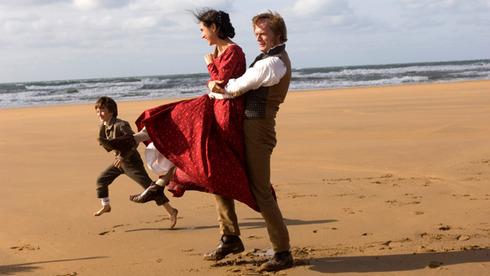
That said, Creation is emotionally engaging and captures the process of creativity as immersive and dangerous, lending a sense of majesty and danger to Darwin’s work. Filled with apocalyptic imagery, sensuality – the reconciliation between the Darwins is movingly intimate, not erotic – and eloquent scenes from nature, it casts the scientist as hero. It offers a real sense of the costs involved and the excitement that Darwin’s idea has inspired.
Ultimately, the film is a remarkable success and an abject failure. As a work of art, it is wonderful, with a strong set of performances and a clear articulation of a dramatic story. Yet in achieving this, it threads Darwin’s life with romanticism and leaves Natural Selection as the product of a specific context and personality. A commendably post-modern notion of scientific theory, perhaps, but not one that neo-Darwinism admires. It is contentious in the same way as The Blind Watchmaker, and offers Natural Selection as an alternative to a brutal religiosity. In allowing Darwin to be an inspirational human rather than a mere icon, it states its claim coherently: the more mythological sequences, such as his turn as Dr Dolittle with a cute orang-utan, muddy the scientific intention.
Gareth Vile
 Visit this film's official web site