
Decolonising development: A call to reimagine mission and solidarity


If your idea of ‘mission’ is shaped primarily by Roland Joffe’s 1986 film, then hearing Laura describe the content of and motivation behind her role as Jesuit Missions’ International Programmes Officer will give you plenty to think about! She speaks with passion, respect and hope on the latest episode of Things I Wish I Knew.
In recent years, the language of ‘decolonising development’ has gained traction across academic, humanitarian and ecclesial spaces. For Jesuit Missions, the international development arm of the Jesuits in Britain, this is not merely a trend but a theological and ethical imperative. Laura Angarita Romero, a development practitioner with Jesuit Missions, invites us to reflect deeply on what it means to accompany communities rather than impose solutions, a posture rooted in Ignatian spirituality and the gospel.
At the heart of Jesuit Missions’ work is a commitment to solidarity with vulnerable communities across Africa, Asia and Latin America. This solidarity is not transactional. It is not about delivering aid from a position of power; rather, it is about walking alongside the marginalised, listening to their stories and recognising their agency. This approach challenges the legacy of colonial development models that often treated communities as passive recipients of Western expertise and charity.
Decolonising development begins with humility. It requires acknowledging the historical and structural injustices that have shaped global inequalities. The Church, including its missionary institutions, is not exempt from this history. Yet, the Ignatian tradition offers a way forward – a spirituality that calls us to ‘see God in all things’, especially in the lives and struggles of the poor. Jesuit Missions embodies this by prioritising relationships over results, presence over programmes.
Laura’s insights echo Pope Francis’ call in Laudato si’ to hear both ‘the cry of the earth and the cry of the poor’. Development, in this light, is not simply about economic growth or infrastructure. It is about restoring dignity, defending creation and fostering peace. Jesuit Missions responds to emergencies, supports refugees and advocates for environmental justice, but always keeps an eye towards empowering local communities to shape their own futures.
This shift in perspective is not easy to achieve. It demands a re-evaluation of power dynamics, funding structures and even language. Terms like ‘beneficiaries’ or ‘target populations’ can unintentionally reinforce hierarchies. Decolonising development invites us to speak instead of ‘partners’, ‘co-creators’ and ‘communities.’ It asks us to listen more than we speak, to learn more than we teach.
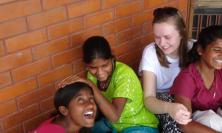
For Jesuit Missions, this means building bridges between schools in the UK and those in the Global South, fostering mutual exchange rather than one-way support. It means preparing volunteers not just to serve but to be transformed by the experience of encounter. It means challenging injustice at both local and governmental levels, recognising that advocacy is as much a part of mission work as accompaniment.
Laura’s work also highlights the importance of storytelling. Development is not only about statistics and reports, but also about human lives. Sharing stories of resilience, faith and hope can dismantle stereotypes and foster genuine connection. In this way, the mission becomes not just a project, but a pilgrimage – a journey of mutual transformation.
The Jesuit emphasis on ‘faith that does justice’ also finds concrete expression in this approach. It is a faith that refuses to be comfortable with inequality, that seeks to heal rather than dominate. Decolonising development, then, is not a rejection of mission but its renewal, a new perspective. It is a return to the gospel’s radical call to love our neighbour, not as an object of charity but as a fellow image-bearer of God.
In a world marked by division and ecological crisis, this vision is urgently needed. Jesuit Missions reminds us that development must be rooted in relationship, justice and hope. It must be shaped by those who live its realities, not dictated by distant agendas. And it must always be open to conversion and to the possibility that in serving others, we ourselves are changed by those we are trying to serve.
Laura’s reflections challenge us to ask: What kind of world are we building? Whose voices are we listening to? And how might we, as Church, become more faithful companions on the journey towards justice?
To hear more about these themes and Laura Angarita Romero’s story on her work, listen to the latest episode of the Things I Wish I Knew podcast. The conversation explores how faith, justice and humility intersect in the pursuit of a more equitable world.
Listen to ‘Things I Wish I Knew About Decolonising Mission Work’; and to get all of our new episodes and catch up on our first series, subscribe now >>
You can follow us on Instagram @tiwik_pod.