
Seeing Christ, living the gospel: Clare’s gift to the Franciscan Jubilee


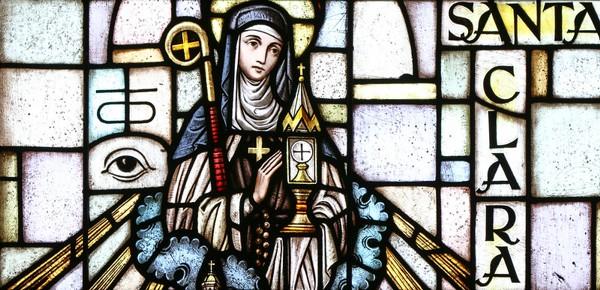
(Photo shared via Creative Commons CC BY-NC-ND 2.0)
11 August is the feast of St Clare, who all-too-often is described simply as ‘St Francis of Assisi's companion’. Brian Purfield shows that Clare offers the Church a distinctive theology of contemplation in her own right, one that illuminates the very possibility of gospel living by inviting us to gaze, consider, contemplate and imitate.
I. Christ calls two disciples into one gospel
The Jubilee of St Francis invites the Church to return with gratitude to the gospel that shaped his life and continues to renew the Church. Yet to remember Francis is also to remember that the gospel he embraced was never lived in isolation. From the beginning, his vocation unfolded within a communion of brothers and sisters who recognised together the call of Christ. Among them, none stands more clearly beside him than Clare of Assisi.
To honour Francis without hearing Clare is, perhaps, to listen with only one ear. Her letters to Agnes of Prague, together with her Testament, Blessing and the witness preserved in the Process of Canonisation, reveal not simply a faithful disciple of Francis but a profound theologian of the Christian life. She writes with the quiet authority of one whose gaze has become steadily fixed upon Christ and who longs to draw others into that same vision.
The story of Francis and Clare is therefore not principally the story of two remarkable medieval saints. It is the story of Christ calling two disciples into the one gospel. Their lives are different, their vocations distinct, yet both are shaped by the same desire: to know Christ poor and humble, and to allow their lives to be conformed to him. Their friendship has endured in the Church's memory because it directs our attention away from itself towards the One who first called them.
Francis is often remembered as the saint who lived the gospel, Clare as the saint who contemplated Christ. Yet this is not a contrast between action and prayer, nor between an active and a contemplative vocation. Rather, it discloses the inner rhythm of every Christian life. The gospel can only be lived because Christ has first been contemplated; contemplation, in turn, always seeks expression in a life shaped by the gospel. Together they reveal the movement of discipleship: seeing Christ and living the gospel. Francis shows what a gospel-shaped life looks like. Clare reveals the contemplative vision from which such a life is born.
II. Recognising Christ together
The early sources tell us that the young Clare was deeply moved when she heard Francis preach. The process of canonisation recalls that she was inspired by his example to leave behind the securities of her former life.[i] Yet what attracted her was not simply Francis's personality or originality. Rather, she recognised in him a life already claimed by Christ. In Francis, she recognised the shape of the vocation that the Spirit had already begun to fashion within her.
The distinction matters. Francis did not give Clare her vocation; Christ did. Francis helped her recognise more clearly the work Christ had already begun. So too, Clare would become for Francis not merely a devoted follower but a companion in discernment, one whose fidelity, wisdom and contemplative depth sustained the Franciscan movement from its earliest years. The witnesses to her canonisation remember Francis visiting San Damiano, the convent where Clare founded her community, and finding there consolation and encouragement, suggesting a friendship rooted not in dependence but in mutual trust before God.
Their companionship is easily sentimentalised, as though its significance lay chiefly in the affection they shared. Clare's own writings suggest something deeper. Christian friendship is born not from two people gazing at one another but from two disciples whose eyes are fixed upon the same Lord. Their unity was not created by their affection for one another but by their shared conversion towards Christ. The more completely Francis and Clare turned towards Christ, the more deeply they were united with one another. Communion with one another is always the fruit of communion with Christ.
III. Learning to see: The mirror of Christ
It is this contemplative vision that becomes Clare's distinctive gift to the Church. Again and again she returns to the language of seeing, beholding and contemplating Christ, until these are revealed as the true heart of discipleship. Only from such contemplation does imitation become possible.
Among the treasures of Franciscan spirituality, few texts invite us more deeply into the mystery of Christ than Clare's fourth letter to Agnes of Prague, in which she offers the luminous image of the mirror.[ii] This does not arise in isolation. It echoes St Paul's conviction that ‘all of us, with unveiled faces, seeing the glory of the Lord as though reflected in a mirror, are being transformed into the same image’ (2 Cor. 3:18). For Clare, contemplation is never passive. To gaze upon Christ is already to begin to be changed into his likeness.
Clare therefore invites Agnes, and every Christian, to: ‘Gaze upon him, consider him, contemplate him, as you desire to imitate him’.[iii] With these words, Clare ceases merely to describe the Christian life; she begins to accompany the reader within it. The order matters. Clare's sequence is not a spiritual technique but a movement of grace. To gaze upon Christ is already to allow him to claim our attention. The disciple is invited to linger before the mystery of the incarnation, the humility of the cross and the glory of the resurrection. Such looking is never superficial. Love always desires to understand more deeply, and so the gaze gives way to consideration. We begin to ponder the mystery that has drawn us, discovering in Christ's poverty and self-emptying not simply virtues to admire but the very revelation of God's love.
Consideration deepens almost imperceptibly into contemplation. The mind no longer analyses from a distance but rests in loving attention. Clare's invitation is not primarily to think about Christ but to remain with him.
The mirror is therefore not simply an object into which the disciple looks. It is the privileged place of encounter between Christ and the disciple. Christ gives himself to the one who gazes upon him, and in that loving exchange the disciple is gradually transformed. Clare’s advice to Agnes is:
Place your mind before the mirror of eternity!
Place your soul in the brilliance of glory!
Place your heart in the figure of the divine substance!
And transform your entire being into an image
of the Godhead Itself through contemplation.[iv]
Here contemplation is not an escape from the demands of the gospel but the very means by which the gospel takes flesh in a human life.
Only then does Clare speak of imitation. By placing this last she overturns any suggestion that holiness begins with effort. The Christian life does not start by asking, ‘What must I do?’ but, ‘Upon whom must I fix my gaze?’ We become like Christ not by anxious striving but because, through grace, contemplation gradually conforms us to the One whom we behold. To imitate Christ is not the beginning of discipleship; it is the flowering of a life that has learned, patiently and lovingly, to remain in his presence.
Conclusion: A jubilee invitation
In this jubilee year we rightly give thanks for Francis and for the gospel that shaped his life. Yet Francis himself would surely direct our gaze beyond himself. Again and again he led others to Christ. Clare now does the same.
Her writings do not ask us simply to admire her holiness or to remember a remarkable chapter in the Church's history. They invite us into the same contemplative journey that transformed her own life. In learning to gaze upon Christ, to consider him, to contemplate him and finally to imitate him, we discover that seeing Christ and living the gospel are not two separate callings but one movement of grace.
Clare's invitation remains as compelling today as it was for Agnes of Prague. In a restless and distracted world, she teaches us to linger before the face of Christ until, almost without noticing, we begin to reflect the One whom we behold. Perhaps the greatest gift of this jubilee will be not only to remember Francis anew, but also to rediscover Clare – not simply as his companion, but as one of the Church's greatest guides into the contemplation of Christ. This is Clare's enduring gift to the Church: she teaches us not simply how to think about Christ, but how to behold him until our lives begin to bear his likeness.
Brian Purfield was a team member at the London Jesuit Centre and worked alongside the Jesuits from 2001-2025.
References to Clare’s writings and early documents are found in Regis J. Armstrong OFM Cap. (trans. and ed.), Clare of Assisi: Early Documents. The Lady (New York, London and Manila: New City Press, 2006).
[i] Process of Canonisation of St Clare, Testimony of Sister Pacifica (First Witness).
[ii] Fourth Letter to Agnes of Prague, §§14-32.
[iii] Clare’s Second Letter to Agnes of Prague, §20.
[iv] Clare’s Third Letter to Agnes of Prague, §§12-14.