
Óscar Romero and Catholic Social Teaching


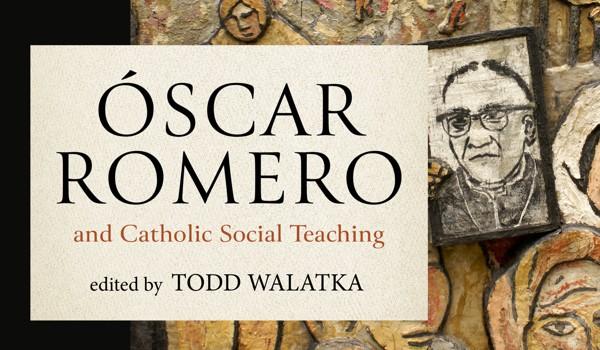
Many of us who have been awed by the sober but passionate courage of St Óscar Romero, by the magnificently rhetorical homilies that, with hindsight, make his assassination seem inevitable, rely on a rather simple, even fuzzy, narrative arc. The introverted, sincere priest of conservative temperament and convictions is transformed by a kind of Damascus flash (the military murder of his priest friend, Rutilio Grande, with manifest state collusion) into a bishop who heroically defies the overwhelming power of the government and military, and seems marked out for martyrdom. This book is a valuable aid to its revision.
Romero was not an academic. But he is admirably served here by academics, the editor and fourteen contributors, who rightly honour someone who lives out their discipline ‘to the end’. (One of them, Jon Sobrino, who knew him well, helped craft some of Romero’s more formal lectures.)
The book is divided into two main sections: part one, ‘Romero in Context’ comprises a biographical account by Ana María Pineda focusing on his earlier life, followed by three discussions of his relationship with Catholic Social Teaching (henceforth CST) at different stages of his life. Part two furthers this relationship to CST, but the chapters are arranged thematically. Edgardo Colón-Emeric writes on the option for the poor; Stephen J. Pope on the common good and economic justice; Elizabeth O’Donnell Gandolfo on the principle of solidarity; Kevin F. Burke on Romero’s peace ministry; and so on. I had half-expected an editorial gesture towards ‘balance’: perhaps a chapter presenting the ‘case against Romero’, which was so freely made by fellow-bishops during his life, and in Rome after his death. There is no such chapter, and I’ll return to this point.
Pineda’s biographical chapter will be revelatory for many. If conversion towards a kind of radicalism seems to need some dramatic trigger by way of explanation, doesn’t Romero’s earlier conservatism equally need explaining? After all, Romero was always serious and prayerful, never acquisitive or power-seeking, and lived in a society where injustice had risen to the level of systemic cruelty.
Pineda writes that, after a serious illness at the age of five left him almost paralysed, Romero had to relearn how to walk, speak and feed himself. He became isolated from other children and sometimes from his family. He consulted a psychologist throughout his life, and reported the doctor’s judgement that he was ‘compulsive, obsessive, perfectionist’.
After ordination in 1943 and a very few months in a rural village, this inward-looking personality was appointed secretary of the diocese of San Miguel, a post he held for more than twenty years. There followed four years as secretary of the Bishops’ Conference of El Salvador, and four years as Auxiliary Bishop of San Salvador before, in 1974, becoming bishop of the poor rural diocese of Santiago de María.
It was this 1974 move which, for the first time, immersed him in the misery of the poor and the oppression which helped cause it. He did not merely change: he allowed himself to change. Pineda reports Romero’s first meeting with the clergy of the diocese: ‘Help me to see clearly’. It seems, therefore, that the 1977 murder of Rutilio Grande was not for him an atrocity out of the blue. It was the decisive confirmation of what he had come to know over three years. By then, as newly appointed archbishop of the capital, he had to confront not just local violence but the governmental-military axis.
Other chapters are no less revelatory than Pineda’s. Michael E. Lee shows that the criticisms levelled at Romero from outside (the seemingly appropriate ‘balance' for a book such as this) are anticipated amply in his own early writings, which Lee cites freely. The early Romero alleged that liberation theology was compromised by its reliance on Marxism, becoming reductionist; that it lacked a supernatural hope and was falsely ‘prophetic’ in promoting political change rather than transcendent conversion. In this period, fully aware of rampant social injustice, he called Christians to spiritual renewal, pastoral charity and a deeper ‘social sensibility’ — calls which in no way threatened the government or the military.
These positions, too, can be in part explained. They emerged from his respectful reading of magisterial documents and his personal presence among, and loyalty to, the conservative episcopacy it was his mission to represent, grafted onto his own temperament. But what you see depends largely on where you stand; after 1974, Romero’s view was increasingly shaped by the people who suffered most and by the atrocities against them perpetrated in the name of anti-communism.
Walatka, in his introduction, and Burke, in his methodologically creative discussion of Romero’s mission for peace (using the poetry of Denise Levertov to structure his chapter), show how Romero’s pastoral letters and homilies were complemented by symbolic prophetic actions. One example is the cathedral misa única of 1977, the extraordinary, surely unprecedented, decision of the new Archbishop of San Salvador to cancel all Masses in the diocese except that in the cathedral, celebrated in the presence of the bodies of Grande and his two companions. He also refused to attend the presidential inauguration of his fraudulently elected namesake, General Carlos Humberto Romero, until the government had properly investigated Rutilio’s murder; he defiantly created a legal aid office; he wrote to President Carter calling for the suspension of USA military aid to El Salvador.
Burke shows how these measures countered other symbolic actions — the grotesque ’aesthetic of terror’, the horrifying details of which were originally documented by the priest and social scientist, Daniel Santiago. Sadistic violence sought not merely to quell the resistance: it was designed to terrorise the population. Romero became convinced that the opposite of peace is not war but violence, and that work for justice was an essential step in the search for peace.
Stephen Pope shows how, in his fourth pastoral letter of 1979, Romero condemned the guerrilla violence, too, without ever equating it with the regime’s violence. He saw the structural violence of dispossession and deprivation as the primary economic injustice. From it arose the repressive violence of the Right (state, military, landowners) that sought to protect the injustice by crushing any opposition, however moderate; on the contrary, the ‘reactive violence’ of the Leftist revolutionaries originated in self-defence. (Pope echoes, consciously or not, a contrast famously described by Franz Fanon in The Wretched of the Earth [1961]).
Whelan focuses on a specific but fundamental instance of this primary economic injustice: the struggle of the rural proletariat (‘those who must sell their labour to survive’) amidst land conflicts caused by the advance of ‘export agriculture’ and by the sprawling landholdings known as latifundia. Here Romero’s advocacy lies in the mainstream (however provocative) of CST. He echoes, for instance, Paul VI’s Populorum progressio of 1967 which, in §24, envisages even the expropriation of latifundia. (Populorum progressio’s position was notoriously described in the Wall Street Journal as ‘warmed-over Marxism’, yet ironically came to be repeated by John Paul II, in speaking to Mexican indigenous in Puebla in January 1979.)
Gandolfo argues an intriguing case about solidarity. Romero spoke of ‘the people’. He meant by this perennially contested term the popular movements for justice, and the suffering and oppressed populations they represented. Romero is rightly regarded as a prophetic voice. Gandolfo shows how he regarded this people as his prophetic voice. They were subjects, not only beneficiaries, of solidarity. The Church itself is ‘a prophetic, sacramental community of love’: and Romero saw this model of Church embodied in the base communities he sponsored in San Salvador. Many thousands of witnesses to faith in El Salvador — along with Óscar Romero — paid with their lives, becoming what Jon Sobrino has called ‘a crucified people’.