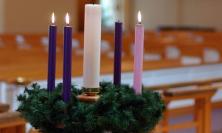

Advent Week 3



Peter Edmonds SJ reflects on the weekday readings for the third week of Advent.
(The dates in brackets refer to the year 2025.)
Monday (15 December): The first Baptist day: Balaam
Numbers 24:2-7,15-17; Matthew 21:23-27
‘John’s baptism: where did it come from: from heaven or man?’ (Matthew 21:25)
Balak was king of Moab. Alarmed at the progress of the invading Israelites who threatened his territory, he commissioned his prophet Balaam to counter this threat by cursing Israel. To Balak’s fury, instead of cursing Israel, Balaam, in a series of oracles, blessed them. He defended his action with an appeal to the God who had authorised them. He could do no other. We hear two of these oracles today. In particular, we notice his words about a star. These prepare us for the star the Magi would follow on their journey to Bethlehem and for Jesus’s own self-description in the Book of Revelation as the ‘bright morning star’.
In his final days in Jerusalem, Jesus was challenged about the authority behind his action in expelling all those buying and selling from the Temple. He refuses a direct answer. Instead he recalls the baptising activity of John the Baptist. By whose authority did he justify his activity? Jesus’s opponents refused to admit that he, like Balaam, was obedient to God.
Even though they were silent about the authority behind the Baptist, Jesus’s critics admitted that John was held by all to be a prophet. Jesus had earlier taught the crowds that ‘all the prophets and the law prophesied until John came’. As for ourselves, the story of the career of John the Baptist helps us appreciate all the more the richness of the Christmas story as the festival rapidly approaches. We are to enjoy the story of Balaam’s talking donkey.
Prayer
Father, the foreign prophet Balaam spoke words that found their fulfilment in the gospel story. May we be alert to the voice of God from wherever it comes, even from a foreigner like Balaam. May Christ be the star that guides us. We make this prayer through Christ our Lord.
Tuesday (16 December): The second Baptist day: The anawim
Zephaniah 3:1-2, 9-13; Matthew 21:28-32
‘For John came to you, a pattern of true righteousness.’ (Matthew 21:32)
Our reading from Zephaniah prepares us for the infancy stories of the gospels. The ‘humble and lowly people’ the prophet speaks of can be recognised in Mary, the mother of Jesus, and in characters like Simeon and Anna who will greet the infant Jesus in the Jerusalem temple. These are God’s anawim, people totally dependent on God for support. Among the suppliants Zephaniah describes who bring offerings from ‘beyond the rivers of Ethiopia’, we may include the wise men from the East, the Magi.
John the Baptist is referred to by name twenty-three times in the Gospel of Matthew. Today we hear his final mention. He is praised by Jesus because he followed the path of righteousness. This is a key word in this gospel. In the Sermon on the Mount, Jesus demanded a righteousness that exceeded that of the scribes and the Pharisees. At his baptism by John, Jesus claims to fulfil all righteousness. In Matthew’s infancy story, Joseph accepted Mary as his wife because he was a ‘righteous’ man.
Passages like this one from Zephaniah help us to understand the mission of the Church to the poor. Jesus’s praise of John the Baptist as one who set a pattern of true righteousness encourages us to live a life that conforms with the way of life Jesus requires of true disciples, those who recognise their dependence on God. If we remember the anawim of the prophet Zephaniah, Jesus’s teaching in the Beatitudes about the ‘poor in spirit’, makes sense.
Prayer
Father, the Church has made her own the ‘preferential option for the poor’ in the tradition of the prophets of Israel and the life and the teaching of your Son. May we treasure all the teaching and example which they provide. We make this prayer through Christ our Lord.
17 December: Son of David, son of Abraham
Genesis 49:2, 8-10; Matthew 1:1-17
‘A genealogy of Jesus Christ, son of David, son of Abraham.’ (Matthew 1:1)
Authors struggle to find attractive openings to their compositions. They know how important it is to grab and keep the attention of their readers to keep them reading their work to its conclusion. Matthew would appear to stumble here because many preachers do all they can to avoid dealing with the genealogy with which he begins his gospel. Although it belongs to his infancy story, it plays no part in the nativity plays that we enjoy as part of our Christmas.
Yet this need not have been the reaction of Matthew’s first readers. If they were of Jewish background, they would have been excited to hear about a ‘son of David’. David was the greatest of the kings of Israel. The prophet Nathan had promised that his ‘throne would be established for ever’. Recent history seemed to contradict this promise; Matthew is insisting that in Jesus, God was being faithful to his ancient pledge. As for ‘Son of Abraham’, this was good news for Matthew’s readers of Gentile background: had not God promised that in Abraham, ‘all the tribes of the earth would find a blessing’?
Matthew names many ancestors of Jesus in his genealogy. Some of them are unknown. Of others we know little and this little may not be edifying. But this list assures us that God works not only through human success and fidelity but also through failure and obscurity too. God builds on our ‘little faith’, just as he built on the ‘little faith’ of Jesus’s ancestors.
Prayer
Father, you are a God who had been labouring through many generations on our behalf as you prepared for the coming of your Son into our world. Confident in your continuing grace, may we continue this work with joy and enthusiasm. We make this prayer through Christ our Lord.
18 December: Annunciation to Joseph
Jeremiah 23:5-8; Matthew 1:18-24
‘Before they came to live together she was found to be with child through the Holy Spirit.’ (Matthew 1:18)
Good teachers lead their pupils step-by-step to bring them to a thorough understanding of a topic. Matthew is such a teacher. He has shown through his genealogy how Jesus’s ancestors included Abraham, the patriarch, and David, the king. His account of the annunciation to Joseph adds further truths for us to make our own.
First, there is the role of the Holy Spirit. Twice he tells us that the mother of Jesus was with child through this Holy Spirit. This Holy Spirit appears in the story of creation when ‘God’s spirit hovered over the water’. This Spirit inspired Israel’s prophets. God promised the prophet Ezekiel that he would send his Spirit to renew his people. At his baptism, Jesus saw ‘the Spirit of God descending like a dove and coming down on him’. Secondly, we must note the names given to this child. He would be Jesus, because he would save ‘his people from their sins’ and he would be Emmanuel, ‘God-is-with-us’. At the end of this gospel, the risen Lord told his disciples that he would be with them ‘to the end of time’.
We can learn many lessons from brief gospel passages like this one about Joseph. May we respond to its message in the way Joseph did by doing what the Lord wants us to do. Paul reminds us that we are ‘temples of the Holy Spirit’. Jesus assures us that ‘where two or three are gathered in my name, I shall be there with them’.
Prayer
Father, you sent your angel to Joseph. We pray that like Joseph, we may always be on the alert to recognise the divine plan for our lives whatever this might be, and, following his example, be eager to put it into practice. We make this prayer through Christ our Lord.
19 December: Annunciation to Zechariah
Judges 13:2-7, 24-25; Luke 1:5-25
‘Then there appeared to him the angel of the lord, standing on the right of the altar of incense.’ (Luke 1:11)
We may be surprised by the beginning of the Gospel of Luke, which we hear today. This gospel is known as the gospel of the Gentiles, yet its beginning is steeped in the atmosphere of Judaism and its scriptures. The language in the Greek original resembles that of the Greek translation of the Hebrew Bible. The God who has been at work in the history of his people, is again responding to their needs.
In the past, he had displayed his mercy in granting children to parents past the age of child bearing. The patriarch Isaac had been the born to Abraham and Sarah; the judge Samuel had been born to Elkanah and Hanna. God had sent his angel to Hagar, the mother of Ishmael, and to the mother of Samson to announce the birth of their sons. The annunciation to Zechariah had greater sanctity because it took place in the Temple in Jerusalem, the holiest place in the holy city. Zechariah should have welcomed all this, but he did not. He was struck dumb; the people waiting outside never received the blessing for which they were waiting.
Our gospel passage begins with a mention of King Herod of Judaea, but he is not mentioned again. The one who is really king is the God behind the story. This teaches us to watch out for the active presence of God not only in the story of Jesus that Luke relates in his gospel, but in our lives and in our history.
Prayer
Father, Zechariah was a priest in your service, privileged to be the father of John the Baptist. May we imitate him in his practice of prayer; may we not fall short as he did in responding to your word in whatever form it comes to us. Through Christ our Lord.
20 December: Annunciation to Mary
Isaiah 7:10-14; Luke 1:26-38
‘“I am the handmaid of the Lord,” said Mary, “let what you have said be done to me.”’ (Luke 1:38)
We are often frustrated when we find a page missing in what we are reading or when we hear only one side of a conversation. We have much to learn about Mary and the child whose mother she is to be from Luke’s report of Gabriel’s message to her, but we may learn even more if we contrast this account with that of the annunciation to Zechariah which preceded it.
This time the angel Gabriel is mentioned at the beginning of the narrative and is said to be sent by God. Our God is a God of initiatives. God’s angel goes to a place never recorded in the Old Testament, far from the holy city of Jerusalem. He speaks not to a Temple priest but to a young unmarried woman. She and the child whose birth is announced are described in language far richer than that applied to Zechariah and to his child John in the previous annunciation story. Gabriel tells Mary: ‘The Lord is with you’. He describes her child as, ‘Son of the Most High’. In fact, Gabriel has much more to say about both.
Luke gives us this information because he wants his Christian audience to know how ‘well founded the teaching is which you have received.’ In the light of this story, he surely wants us respond as Mary did to the message of the angel: ‘I am the handmaid of the Lord.’ The angel’s message is directed to all of us.
Prayer
Father, we venerate Mary not only as Queen of Heaven but also as the perfect Christian disciple. May we too be covered by the power of the Most High and through her prayers and in her company help bring Christ to birth in our unbelieving world. Through Christ our Lord.