
Hopkins’ Advent nightmare: Celebrating the memory of the wreck of the Deutschland


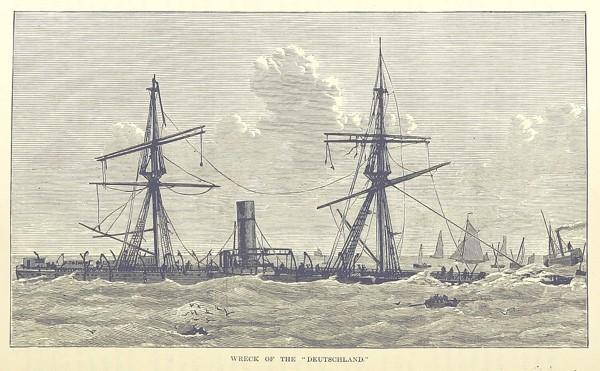
The sinking of a passenger ship that inspired Gerard Manley Hopkins to write one of his most celebrated poems occurred 150 years ago this weekend. That we observe this anniversary during Advent is fitting, says Michael Barnes SJ, as the arc of the Wreck of the Deutschland reflects the tenor of the season: ‘In this moment of winter darkness, there is yet always a divine warmth, if we will but look for that new dawn and receive it and praise God for the little we can see.’
On the night of 6 December 1875, a passenger ship left the German port of Bremen to cross the Atlantic to New York. Among the passengers were five Franciscan nuns escaping religious discrimination in their own country and looking forward to being able to pursue their mission in freedom in the New World. Their flight was the direct result of the notorious Falk Laws, enacted during Bismarck’s anti-Catholic Kulturkampf between 1873 and 1875, and intended to make the Church subject to state control in many aspects of its public life.
The ship was called the Deutschland. Soon after leaving Bremen it ran into a violent storm, and during the night of 6 December it ran aground on a sandbank on the North Kent coast and broke up. Some 57 passengers perished, including the five nuns. The tragedy was fully reported in the British press and made a deep impression on the rector of St Beuno’s, the Jesuit theological college in North Wales. In conversation with a young student, he said he wished someone could memorialise this event with some suitably brief verses.
The young Jesuit was, of course, Gerard Manley Hopkins. Born into a High Church Anglican family in Stratford, Essex, in 1844, educated at Highgate School and Balliol College, Oxford, he was received into the Catholic Church by John Henry Newman in 1868 and entered the Jesuit novitiate at Roehampton two years later. At that point he decided that writing poetry was incompatible with his new vocation and burned all his work. But – like a good Jesuit – the merest hint from his superior was enough to make him return to his former passion. Over the coming months he wrote the Wreck of the Deutschland. It is anything but brief – 35 stanzas, packed full of Hopkins’ typical imagery, phrasing and pulsating rhythms, which were to become so familiar in the poetry that later flowed from his fertile imagination. Notoriously this magnificent work of art, one of the greatest and most influential poems in the English language, was sent to the editor of the Jesuit journal, The Month, who thought it too difficult for his readership. It was never published in Hopkins’ lifetime; that didn’t happen until 1918, by which time he had been dead for nearly forty years. His premature death carries a heart-breaking poignancy. This brilliant and sensitive mind, a magnificent artist, never enjoyed any sense of recognition and success in his short life.
Why bring Hopkins into a reflection on the meaning of Advent? Not just because the date marks the 150th anniversary of the event which inspired the Wreck but because there’s something about the mood or feel of these dark, wintry months that consoles and inspires while yet challenging the depth of our understanding of the ways of God. Advent, of course, marks the turning of the Church’s liturgical year. After 34 weeks of ‘ordinary time’ we enter into a season of hope, and are encouraged to look forward to the coming of the Lord and the dawning of a new creation. But where human emotions and sensibilities are concerned, the drawing of lines is never that straightforward. The ‘mood’ of one season often filters through into another.
This year, the final weekday readings after the feast of Christ the King focused relentlessly on the book of Daniel. The young prophet is adept at interpreting the visions of the Babylonian kings as they confront the nightmares that arise from the depths of their subconscious. Yet he is not safe from his own moments of horror, finding himself cast into the lion’s den, the nightmare of a prophet which no doubt has origins in the recurrent nightmares of the people of Israel, lost in the desert, exiled miles from home, victims of cruel kings and violent regimes, and tested to the limits of their endurance.
With Advent all that stops – or is intended to stop. We are asked to move from the subconscious ‘other’ world, back to this world of everyday waking consciousness. The words of Jesus are intended to put nightmares, dreams, visions, to one side. On the first Sunday, the Jesus portrayed in Matthew’s Gospel exhorted us to ‘stay awake’, for we do not know the times of the Lord’s appearing. They sound like threatening words, words of warning, and it’s easy to miss the deeper tones of consolation. In the middle of our daily activities – eating, drinking, taking wives and husbands (and there is no indication that any of this is wrong) – we are exhorted to wake up to the action and presence of our God. God is here and now, in the middle of it all. Just be aware of what God is doing.
And what is God doing? The gospel which we read this second Sunday introduces a familiar Advent figure, John the Baptist, with the message, ‘Repent, for the kingdom of heaven is close at hand’. The Baptist is no visionary, a wise latter-day Daniel come to interpret troublesome dreams and comfort a persecuted people. If he fits the category of prophet, it is not because he calls out the religious élite – though, of course, that is exactly what he does do. Rather, he is haunted by the imminent coming of the Christ of God who will do more than call sinners to repentance. ‘He will baptise you with the Holy Spirit and with fire’. Again, it all sounds threatening – and this time we need to dig even deeper to pick up any message of consolation.
If the first week of Advent is about time reaching a certain climax or focus, around which everything we experience comes together – confidence and fear, joy and anxiety - the second reminds us that to embrace this moment of time, what confronts us in the here and now, demands faith and courage. The great Advent virtue of hope can be troublingly elusive, for there is always a limit on what we can possibly know about the future. Indeed, hope would not be hope if it could be easily subverted into a comforting assurance that all be well, whatever we do – or fail to do. The crowds John the Baptist encountered, and the ‘brood of vipers’ he fulminated against, were united in their longing to hear a genuine prophet who would restore the fortunes of Israel. Otherwise they were tragically divided, held by very different – even confused – ideas about the nature and object of their hope. What are we looking forward to? When will God come? How will God come? What is to be done to make ourselves ready?
And it’s then, in this moment of crisis, between the past and its nightmares and a future with its dreams of something more consoling and hopeful, that so often something dreadful happens. Not what we may want, some mythical nightmare we can identify as terrorising the world, but a tragedy much closer to home, albeit ‘out there’ in the darkness that surrounds us, which somehow becomes painfully close.
On 6 December 1875 in North Wales, Advent had just begun. Hopkins was experiencing what he calls in his poem a ‘winter and warm’. Then off the Kentish coast, innocent lives are lost to a terrifying storm; nature hits back, overwhelming the best efforts of human beings to tame its unpredictable power. This is what Hopkins experienced, what the philosophers call the ‘problem of evil’. How can a good God allow the nightmare of evil to flourish? Five faithful nuns, dedicated to the cause of God, fleeing from persecution, are overtaken by a violence they are powerless to resist. It doesn’t have to be a natural disaster. It can be the brutality of war that kills innocent women and children. It can be the unchecked power of the few which destroys the lives of many. Or it can be the death of a prophet – or even God’s own Messiah, betrayed by one of his own and done to death by a vengeful mob. The oldest complaint in the book belongs to the psalmist who asks why the innocent suffer and the guilty go unpunished. Consolation and hope, let alone truth and justice are hard won by those who can only lament and cry out to God: ‘vindicate my cause, O God, against those who seek to do evil to me!’
To read the Wreck of the Deutschland is to experience anguish and empathy for the innocent who suffer. This is not an intellectual exercise, a rational justification of the ‘problem’ of evil. The whole conception is very different, part autobiographical, part dramatic construction, part evocative of that mystery of things which defies the very attempt to move beyond mere description of this brute stuff that makes up our world. How to make sense of it all? For Hopkins, the mysteries of God, creation and humankind are held together, envisioned through a single historical event. Words and phrases, imagery and metaphor, sounds and cadences, mirror the horror of what has happened and take us deep into the soul of a man wrestling with his own faith. After the relative clarity of his early conversion, he finds the world that is God’s own creation still churning with the force of nightmarish pain and destruction. Yet in Hopkins’ vision it only begins to make sense when read through the lens of the incarnation, God revealed at the heart of the world. Paradoxically it seems as if the only ‘explanation’ that is worth anything comes when words are invoked to inform the drama – even when they halt and fail. The suffering Christ in whom the world is created is made manifest in every terrible experience of pain and loss.
So what difference does Advent make? The courage of faith is not that we know and can somehow predict a more hopeful future. All we know is that, despite recurrent nightmares, something new is coming – and it comes out of our experience, and the contingencies of our history, our ‘here and now’. That is precisely not to say lines can be easily drawn, the past can be safely forgotten. Rather we can take heart that God is in the middle of it all; God comes to meet us, embraces all that has brought us to this point, and still brings new life to birth. Hopkins finds words – and, perhaps more important, the rhythm of words – which remind us that faith, hope and love are gifts of God, and they are given. In this moment of winter darkness, there is yet always a divine warmth, if we will but look for that new dawn and receive it and praise God for the little we can see. Maybe the last words of the Wreck can act as an Advent prayer, as they were for Hopkins, not a resolution of the ‘problem of evil’ but a moment here and now to stake our poor humanity on a courageous hope.
Let him easter in us, be a dayspring to the dimness of us, be a crimson-cresseted east,
More brightening her, rare-dear Britain, as his reign rolls,
Pride, rose, prince, hero of us, high-priest,
Our hearts' charity's hearth's fire, our thoughts' chivalry's throng's Lord.
Michael Barnes SJ is a theologian and writer who taught theology of religions and Jewish-Christian relations at Heythrop College, University of London.